 Not sure what you need?
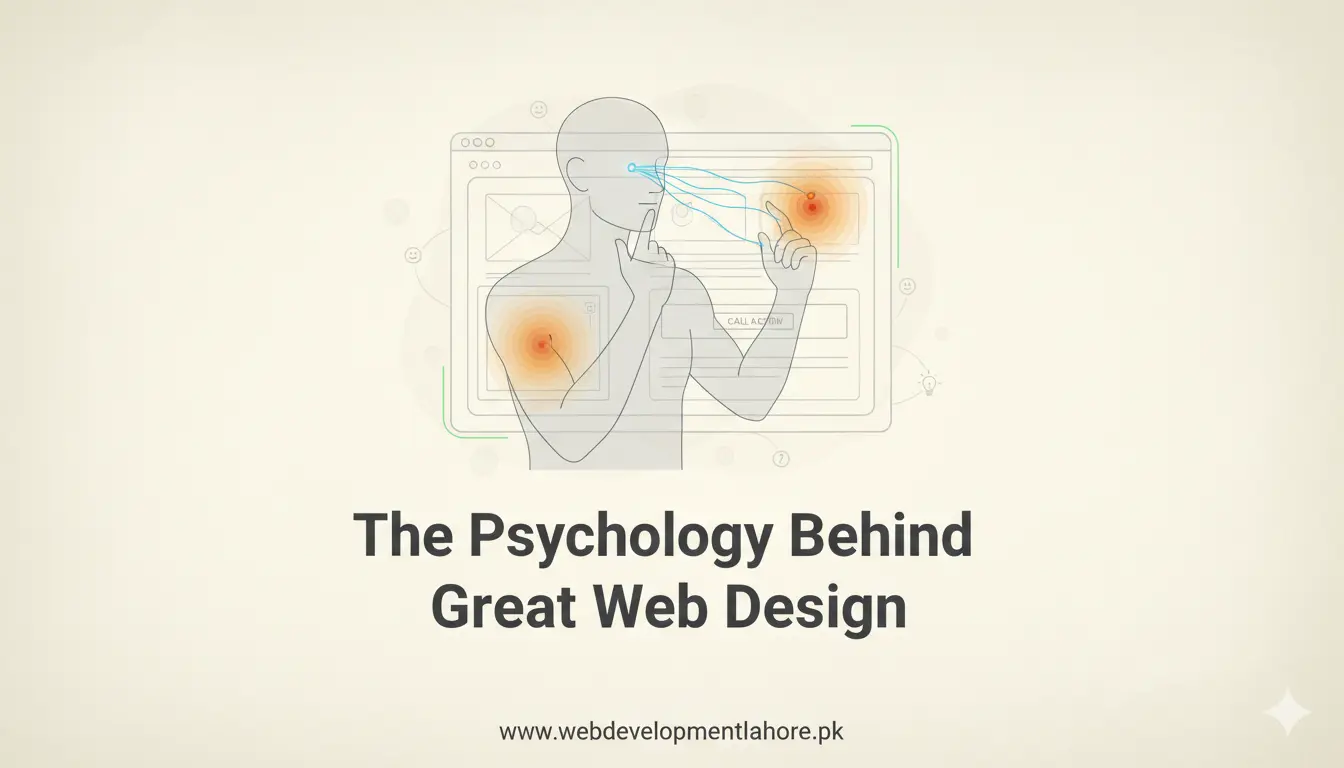
Quick answer: The psychology of web design is about how people judge, read and act on a website. Visitors form a first impression in a fraction of a second, judge credibility largely by how a site looks, scan instead of reading, and get stuck when there are too many choices. Good design uses these patterns: a clear visual hierarchy, few choices per screen, familiar layouts, visible trust signals and obvious next steps.
How fast do visitors judge a website?
Very fast. In a well-known 2006 study, Lindgaard and colleagues found that people formed a reliable opinion of a web page’s visual appeal after seeing it for only 50 milliseconds. That first impression then colours how they judge everything else on the site.
What this means for you: the top of your homepage must look clean and professional immediately. A dated layout, a slow-loading slider or a cluttered first screen can lose a customer before they read a word.
Why does design affect trust and credibility?
Stanford University’s web credibility research asked more than 2,500 people how they judged websites. The most common factor people mentioned was the site’s design look, mentioned in about 46% of comments. People use visual quality as a shortcut for how trustworthy a business is.
Practical trust signals that work for Pakistani businesses:
- real photos of your team, office or work instead of stock images,
- your address, phone number and WhatsApp clearly visible,
- Google reviews and real project examples,
- clear prices or a “starting from” price,
- a secure (https) site that loads quickly on mobile data.
Which psychology principles shape good web design?
| Principle | What it says | How to use it |
|---|---|---|
| Hick’s law | More choices take longer to decide | Keep menus short and use one main call to action per section |
| Fitts’s law | Bigger, closer targets are faster to tap | Make buttons large, especially on mobile; keep WhatsApp and call buttons within thumb reach |
| Jakob’s law | Users expect your site to work like other sites they use | Logo top left, menu at the top, contact in the footer; avoid strange navigation |
| Cognitive load | The brain can only process so much at once | Short paragraphs, white space, one idea per section |
| Visual hierarchy | Size, colour and position tell people what matters first | One clear headline, then supporting text, then the button |
| Von Restorff effect | Things that stand out are remembered | Use one accent colour only for your main action |
| Social proof | People follow what others do and trust | Show reviews, client logos and project results near decisions |
| Serial position effect | People remember the first and last items best | Put key services first and your strongest call to action last |
How do people actually read web pages?
Most visitors scan. Eye-tracking research by the Nielsen Norman Group found that people often scan text-heavy pages in an F-shaped pattern, reading the first lines and the start of later lines. Help them scan:
- use question-style headings that match what people want to know,
- start sections with the answer, then explain,
- use bullets, short paragraphs and tables,
- bold only the few words that really matter.
How does colour influence visitors?
Colour affects mood and attention, but there is no magic colour that converts everyone. Contrast matters more: your main button must stand out from the background, and text must be easy to read. Keep brand colours consistent so visitors recognise you. Our post on colour psychology in web design covers this in more detail.
Why does local relevance matter for Pakistani audiences?
People trust businesses that feel close and familiar. For Lahore and Pakistani customers, that means local phone numbers and WhatsApp, prices in PKR, local payment options such as cash on delivery, JazzCash and Easypaisa, addresses and areas they recognise, and Urdu or bilingual content where your audience needs it.
How do we apply these principles at Web Development Lahore?
We design the first screen of every website to pass the first impression test: a clear headline, proof and one main action. Our UI/UX design process starts with user research and wireframes, and every layout is tested on real phones as part of our responsive web design work. You approve the homepage design before we build the rest.
Is your website losing visitors in the first few seconds? Get a free website review from our team in Lahore. See our web design services or WhatsApp +92 323 9587877.
Frequently asked questions
What is the psychology of web design?
It is the use of how people perceive, decide and behave to design websites that are easy to understand, trustworthy and persuasive.
How long does it take a visitor to judge a website?
Research found that people form a visual first impression in about 50 milliseconds, then decide within seconds whether to stay.
What makes a website look trustworthy?
A clean, professional design, real photos, visible contact details, reviews, clear prices and a fast, secure site.
Does web design psychology help sales?
Yes, when it reduces confusion and builds trust. Clear hierarchy, fewer choices and strong social proof make it easier for visitors to contact you or buy.
Sources: Lindgaard, G. et al. (2006), “Attention web designers: You have 50 milliseconds to make a good first impression!”, Behaviour and Information Technology; Fogg, B.J. et al. (2002), “How Do People Evaluate a Web Site’s Credibility?”, Stanford Persuasive Technology Lab; Nielsen Norman Group eye-tracking research on F-shaped reading patterns.